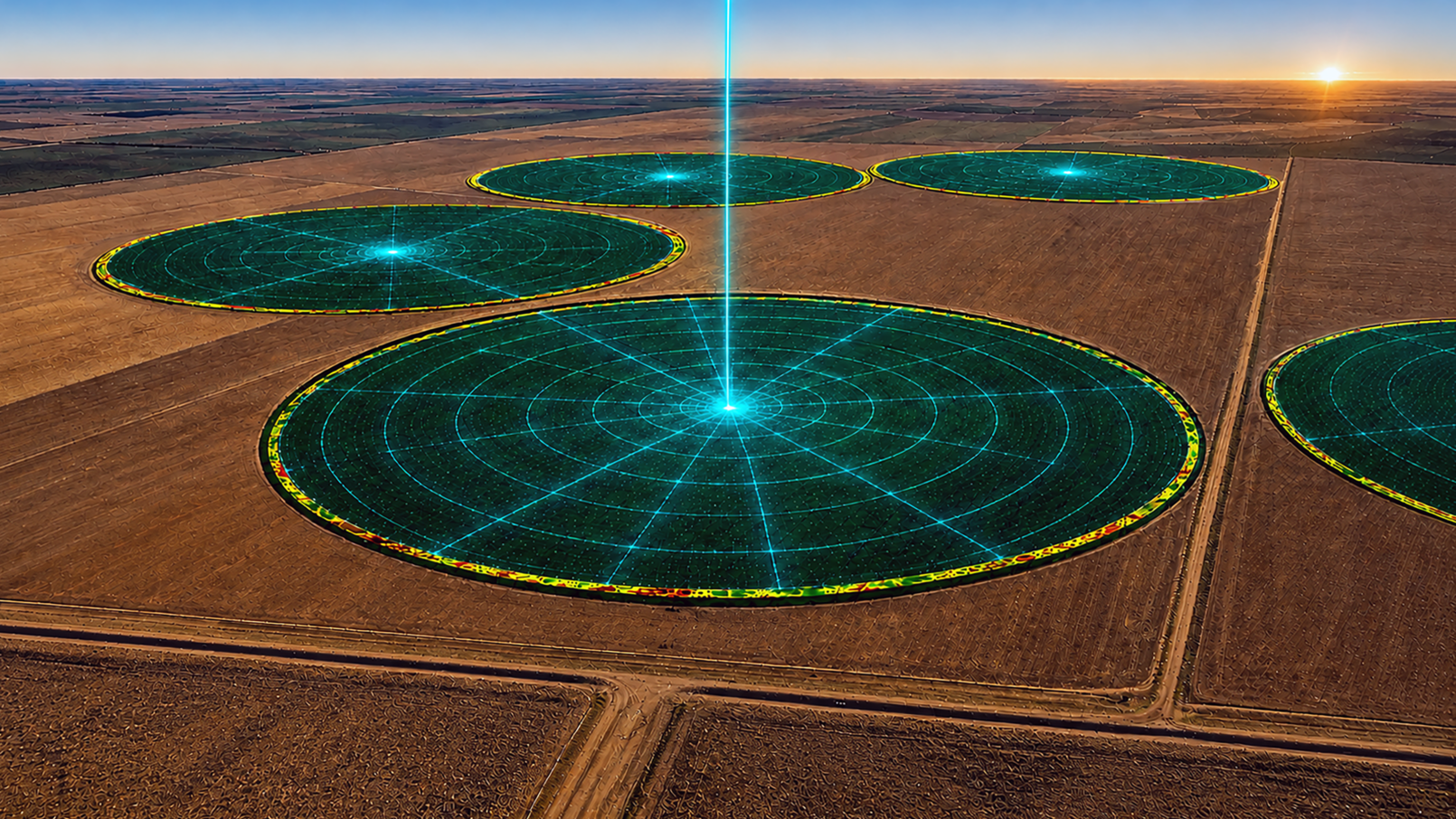
A Blueprint for the Future of Farming

Accelerating Agriculture's Transition to Abundant Intelligence

Chapter 1

The Vision

Accelerating the transition

The race for agronomic intelligence will be won by whoever can continuously generate and aggregate diverse, full-season, high-fidelity proprietary intervention-and-response datasets at the greatest speed and largest scale.

More fundamentally, the next frontier of agricultural AI will be built not only on machines that can autonomously act in the field, but also on machines that can enable self-improving agronomic intelligence—continuously learning over time and across space from the biological consequences of their actions.

This will require fleets of multifunctional agronomic machine platforms that can (1) autonomously execute and vary a wide range of field-scale agronomic interventions, (2) autonomously capture plant-level observations of real-world biological crop responses across successive time intervals, (3) continuously learn from those responses and inform subsequent agronomic decisions, and (4) recursively compound self-improving agronomic intelligence over entire growing seasons and across distributed machine networks—all while remaining physically resident in the field with the crop.

Irrigation pivots are uniquely positioned to form these fleets of new agronomic data and intelligence hubs—establishing a persistent, bidirectional “proprietary AI data channel” through which farmer-developed knowledge and expertise, agronomic intervention histories, successive plant-level observations of real-world biological crop responses, and increasingly intelligent machine actions are continuously integrated and translated into self-improving agronomic intelligence that compounds over time and across distributed machine networks.

These massive, all-electric field machines represent one of the most under-leveraged assets in production agriculture—and one of the most strategically important physical platforms for continuously advancing increasingly capable, self-improving agronomic intelligence and autonomous crop management at the speed and scale required to enable fully autonomous farming systems.

Irrigation pivots provide persistent access to some of the world’s most intensively managed row-crop acres within a uniquely controlled irrigation environment—making these acres the most strategically valuable for continuously generating and aggregating diverse, full-season, high-fidelity proprietary intervention-and-response datasets across machines, fields, crops, geographies, and growing seasons that are essential to training, improving, and differentiating the agricultural AI that will define the future of farming in the Intelligence Age.

Through years of focused development, Fieldbot—operating at the edge of the legacy irrigation pivot industry yet within the broader agricultural equipment and technology sector—has successfully developed and patented a new universal precision upgrade platform capable of transforming—without replacing existing equipment—the world’s installed base of mixed-fleet, electrically driven irrigation pivots into a distributed network of intelligent, connected, autonomous crop platforms—creating a scalable Physical AI infrastructure layer for the continuous advancement of increasingly capable, self-improving agronomic intelligence and autonomous crop management.

Chapter 2

The Transformation

Scaling the network

Operating continuously above the crop canopy throughout the entire growing season, each upgraded irrigation pivot can autonomously apply and record the use of water, fertilizers, and crop protection products; monitor and record real-time environmental conditions; and autonomously capture high-resolution multispectral crop imagery repeatedly after each application—connecting participating farmers’ agronomic interventions directly to subsequent biological crop responses.

Using data provided by customers who elect to license it, Fieldbot continuously generates and aggregates diverse, full-season, high-fidelity proprietary intervention-and-response datasets that transform traditionally fragmented agronomic information—and generations of farmer-developed knowledge and expertise—into structured, proprietary AI data.

Unlike satellites, drones, or other remote-sensing platforms that are primarily designed to observe—and seasonal farm machinery that performs discrete operations and then exits the field—upgraded irrigation pivots remain physically resident in the field with the crop throughout the entire growing season.

Because they remain physically resident with the crop, upgraded irrigation pivots can repeatedly sense environmental conditions and crop needs, inform and enhance farmers’ agronomic decisions, autonomously apply crop inputs, capture successive plant-level observations of biological crop responses at near-zero marginal cost, continuously generate and aggregate diverse, full-season, high-fidelity proprietary intervention-and-response datasets, and repeat—creating a persistent, closed, and compounding Physical AI learning loop between agronomic intervention and biological crop response that senses, reasons, acts, observes, learns, and repeats.

Combined with customer-provided planting and harvest data, these diverse, full-season, high-fidelity proprietary intervention-and-response datasets can continuously train, improve, and differentiate proprietary agricultural AI models—or post-train, ground, and specialize increasingly capable frontier AI models for agricultural applications—enabling those models to learn from crops across millions of engaged acres and build an increasingly differentiated understanding of planting performance, crop health, water demand, nutrient response, disease and insect pressures, crop-input effectiveness, and yield outcomes with every field and every growing season.

Integrated with third-party cloud-based digital farm management platforms, Fieldbot can add a persistent biological crop-response layer to existing planting, application, machine, weather, and harvest datasets—connecting what farmers and machines do in the field with how crops respond biologically throughout the entire growing season.

The result is a self-reinforcing agronomic intelligence network—more connected machines generate more proprietary AI data; more data trains better models; better models produce better intelligence; and better intelligence drives better outcomes and increasingly autonomous machine actions.

As the network scales, each additional machine, field, crop, geography, and growing season strengthens the entire system, both expanding the network of Physical AI learning loops and accelerating the rate at which the network learns.

Chapter 3

The Thesis

Compounding the intelligence

Over time, this distributed network of Physical AI learning loops—and the diverse, full-season, high-fidelity proprietary intervention-and-response datasets continuously generated and aggregated across it—becomes Fieldbot’s most enduring and strategically valuable asset, creating an increasingly differentiated, self-improving agronomic intelligence layer that can continuously train, improve, and advance proprietary agricultural AI models—or post-train, ground, and specialize increasingly capable frontier AI models for agricultural applications—while powering specialized agricultural AI agents and AI assistants.

Agricultural AI models learn patterns from proprietary agronomic data to generate predictions, insights, and recommendations; agricultural AI agents use that intelligence to reason, make decisions, and autonomously pursue defined agronomic goals and objectives; and agricultural AI assistants provide farmers and agronomists with an intuitive interface to access, interpret, and apply that intelligence in everyday decision-making.

Each agronomic intervention, observed biological crop response, subsequent machine action, and resulting crop outcome completes another Physical AI learning cycle across the farm-facing physical agronomic learning rail—creating an expanding base of continuously compounding, self-improving agronomic intelligence that competitors cannot readily replicate with software, remote sensing, or static datasets alone.

As this self-improving agronomic intelligence compounds across machines, fields, crops, geographies, and growing seasons, the proprietary agricultural AI models—and the agentic harnesses wrapped around them—accumulate not merely more agronomic data, but an increasingly differentiated understanding of how crops respond biologically to specific agronomic interventions under real-world conditions.

The resulting proprietary intervention-response-action learning system creates an increasingly difficult-to-replicate competitive moat—built through years of physical interaction with crops, continuously reinforced by new agronomic data, and strengthened with every learning cycle, every growing season, and each additional upgraded irrigation pivot across the network.

Built on increasingly capable agricultural AI models and differentiated by self-improving agronomic intelligence, specialized agricultural AI agents and AI assistants can provide farmers with increasingly personalized, context-aware intelligence across planting, soil health, weather and risk, irrigation scheduling, crop nutrition, crop protection, harvesting, and other agronomic disciplines.

Ultimately, this continuously compounding, self-improving agronomic intelligence can put an increasingly capable “agronomist in every pocket”—giving every farmer, anywhere in the world, access to personalized agronomic intelligence that continuously learns from real-world agronomic experience across an ever-expanding network of machines, fields, crops, geographies, and growing seasons.

What begins with the world’s installed base of mixed-fleet, electrically driven irrigation pivots can ultimately extend to every machine and every “irrigated and non-irrigated” acre worldwide—providing the foundation for abundant, self-improving agronomic intelligence by becoming the farm-facing physical agronomic learning rail that underlies and enables proprietary agricultural AI—the operating system of agriculture—connecting machines, fields, crops, and farmers worldwide.

The self-improving agronomic intelligence thesis is simple: Deploy the technology. Capture the market. Harvest the data. Close the loop. Train the models. Compound the intelligence. Enable the operating system.

Chapter 4

The Partner

Entering adjacent markets

To capitalize on the enormous commercial potential of the global installed base of mixed-fleet, electrically driven irrigation pivots, Fieldbot seeks to partner with a global agricultural technology leader that serves the broader agricultural market but operates independently of the incumbent irrigation pivot OEMs—a partner focused on outcomes, not just tools, with the established sales, service, distribution, and customer-support infrastructure required to rapidly scale a transformative, category-defining technology platform across the global installed base.

Unencumbered by legacy irrigation product portfolios, entrenched industry relationships, or the need to protect an existing irrigation business model, the strategic partner could aggressively leverage Fieldbot’s patented technology to enter an adjacent agricultural equipment and technology market—establishing a new solutions platform for developing and commercializing products, technologies, applications, business models, and autonomous capabilities without disrupting its dealer network, core businesses, or existing revenue streams.

This alliance would give Fieldbot the scale, market reach, and installed-base access needed to accelerate global customer adoption, while giving the strategic partner a protected pathway into mechanized irrigation—and, more importantly, control of an entirely new, scalable Physical AI infrastructure layer for harvesting AI training data, continuously advancing increasingly capable, self-improving agronomic intelligence, and enabling autonomous crop management.

By connecting autonomous machine action directly to real-world biological crop response across millions of engaged acres, this infrastructure can—using data licensed from customers—continuously generate and aggregate the diverse, full-season, high-fidelity proprietary intervention-and-response datasets required to continuously train, improve, and differentiate proprietary agricultural AI models—or post-train, ground, and specialize increasingly capable frontier AI models for agricultural applications—creating a compounding agronomic intelligence advantage that becomes more valuable with every connected machine, field, crop, geography, and growing season.

In doing so, the strategic partner would be positioned not simply to participate in the future of agricultural AI, but to own one of its foundational Physical AI infrastructure layers—creating the potential to build the world’s foremost agricultural AI infrastructure platform and, ultimately, to become the next trillion-dollar AI company.

Chapter 5

The Mission

Unlocking the potential

Q: How can humanity accelerate agriculture’s transition to abundant intelligence that enables fully autonomous farming systems capable of sustainably feeding a growing world?

A: By building the scalable Physical AI infrastructure layer through which agronomic intelligence can continuously learn, improve, and compound in the real world.

Ultra-high-speed is the key.

Fieldbot holds that key—unlocking what could become agriculture’s most valuable proprietary AI data network and the foundation for the next generation of self-improving agronomic intelligence.

By upgrading virtually any brand, make, and model of electrically driven irrigation pivot manufactured since 1969, Fieldbot enables farmers to lower labor requirements, increase machine productivity, improve operational efficiency, and maximize profitability across three core ultra-high-speed machine applications: (1) autonomous crop protection, (2) variable-frequency irrigation, and (3) autonomous crop imaging.

At the same time, every upgraded irrigation pivot becomes a connected node in an emerging network of Physical AI learning loops—continuously generating and aggregating diverse, full-season, high-fidelity proprietary intervention-and-response datasets, improving customer outcomes, and expanding the proprietary AI data foundation from which increasingly capable proprietary agricultural AI can continuously learn, improve, and compound.

Rather than “replacing the iron,” Fieldbot is transforming the world’s installed base of mixed-fleet, electrically driven irrigation pivots into an intelligent, connected, autonomous fleet—repurposed for entirely new capabilities, greater precision, and the continuous advancement of increasingly capable, self-improving agronomic intelligence and autonomous crop management.

Chapter 6

The Company

Transforming Irrigation Pivots

Artificial intelligence is built on a rapidly evolving technology stack that includes energy and power systems; chips, memory, storage, and compute; connectivity and cloud infrastructure; algorithms, AI software, and foundation models; and, critically, the proprietary AI data and high-quality datasets required to train, post-train, improve, and differentiate those models.

Fieldbot operates at the physical edge of this AI stack—where the digital world meets real-world agriculture.

By transforming irrigation pivots into intelligent, connected, Physical AI–enabled agronomic machine platforms equipped with motors, controls, sensing, data, compute, and connectivity, Fieldbot provides the physical infrastructure required to autonomously execute and vary a wide range of field-scale agronomic interventions, autonomously capture plant-level observations of real-world biological crop responses across successive time intervals, and continuously generate and aggregate diverse, full-season, high-fidelity proprietary intervention-and-response datasets.

While power and chips provide the compute and algorithms provide the intelligence architecture, Fieldbot is building something equally fundamental and far more difficult to replicate: a new, persistent, bidirectional proprietary AI data channel connecting machine action to biological crop response across an ever-expanding network of machines, fields, crops, geographies, and growing seasons.

As increasingly capable model architectures and algorithms become broadly accessible, the enduring advantage in agricultural AI may therefore lie in continuous access to diverse, full-season, high-fidelity proprietary agronomic datasets from which those models can continuously learn, improve, and compound.

This Physical AI infrastructure layer—and the full-season, high-quality proprietary intervention-and-response datasets it generates and aggregates—can continuously train, improve, and differentiate proprietary agricultural AI models—or post-train, ground, and specialize increasingly capable frontier AI models for agricultural applications—while powering specialized agricultural AI agents and AI assistants, positioning Fieldbot as a leading Physical AI technology company with a critical AI infrastructure platform for the rapidly emerging agricultural AI economy.

Fieldbot is a California-based agricultural technology firm—built to run fast and evolve quickly—developing Physical AI-enabled autonomous retrofit solutions for irrigated farming operations and rapidly advancing “smart agriculture” by transforming existing farm machinery into intelligent, connected, autonomous crop platforms.

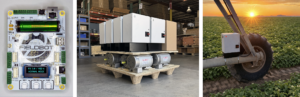
The Fieldbot Precision Upgrade Kit (PUK), featuring patented FastMove™ technology, is a single SKU that universally transforms existing mixed-fleet, electrically driven irrigation pivots into intelligent, connected, autonomous crop platforms. Manufactured and supplied by agriculture’s global leader in electric motors and powertrain products, the complete kit integrates Starlink space-based broadband connectivity, an on-pivot Sentera Field Vision remote-sensing system, high-speed center drive gearmotors, and networked onboard edge-computing units—and installs on virtually any irrigation pivot in a single day.

Fieldbot has invented an autonomous, category-defining, field-scale agronomic machine platform.

Its patented universal Fieldbot Precision Upgrades are positioned to modernize global crop production by equipping the world’s installed base of more than 500,000 irrigation pivots—built on largely standardized machine architecture, powered by over 3.5 million electric powertrains, and collectively irrigating more than 56 million acres across approximately 100 crop types in over 100 countries—with the motors, controls, sensing, data, compute, and connectivity required to transform these massive field machines into intelligent, connected, autonomous crop platforms capable of sensing, reasoning, acting, observing, learning, and repeating throughout the entire growing season while producing the world’s food, fiber, fuel, and feed.

This vast installed base represents a multi-billion-dollar captive irrigation pivot aftermarket opportunity.

Chapter 7

The Machine

Performing Multiple Functions

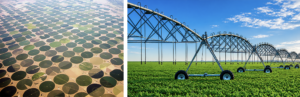
Irrigation pivots, or simply “pivots”—also referred to as center pivot irrigation systems or, internationally, centre pivot irrigation systems—are large, typically electrically driven, self-propelled overhead sprinkler systems used in row-crop agriculture that move in a circular pattern around a central pivot point, with center-fed, pressurized irrigation water generally delivered through large-diameter underground piping supplied by an electric pump drawing from a groundwater well or surface-water source.

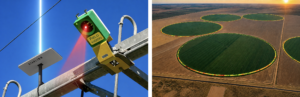
A typical irrigation pivot is approximately 1,320 feet (400 meters) long, consists of seven independently driven wheel towers supporting approximately 180-foot (55-meter) pipe spans, and irrigates approximately 125 acres (50 hectares) as it rotates around the central pivot point, tracing a circle roughly half a mile in diameter.

Irrigation pivots are uniquely capable of combining three field-scale agronomic interventions with a fourth, multimodal crop-sensing capability: (1) irrigation, the application of water to soil and crops; (2) fertigation, the application of nitrogen fertilizer and other nutrients through direct injection into the center-fed, pressurized irrigation water supply; (3) chemigation, the application of irrigation-labeled chemical and biological crop protection products, also referred to as crop protectants, through direct injection into the center-fed, pressurized irrigation water supply; and (4) remote sensing, the use of on-pivot cameras and multispectral sensors to capture high-resolution crop imagery at a plant-level and detect plant “optical signals.”

Similar mechanized irrigation systems include linear irrigation systems, or simply “linears,” and lateral move irrigation systems, or simply “laterals.”

Chapter 8

The Landscape

Leading Irrigation Method

An astounding 28 million acres—approximately 53% of all irrigated acres in the United States—are irrigated by irrigation pivots, according to the USDA’s 2023 Irrigation and Water Management Survey, making irrigation pivots the nation’s leading agricultural irrigation method.

Yet virtually every electrically driven irrigation pivot in operation today remains fundamentally based on the original 1969 drive architecture embodied in U.S. Patent No. 3,608,826, with remarkably little change to its underlying electromechanical design in more than half a century.

Integral to this more than 50-year-old legacy architecture is the “start-stop move” operation of multiple intermediate wheel towers, which maintain alignment and propel the overhead pipe spans in a circular pattern around the field.

Remarkably, virtually all of the more than 500,000 irrigation pivots operating worldwide are fundamentally standardized across OEM brands around the same electromechanical drive architecture, relying on the same decades-old start-stop move drive method.

This one single point of standardization creates a unique opportunity.

Each intermediate wheel tower of the vast majority of conventional irrigation pivots maintains alignment of the approximately 180-foot (55-meter) pipe spans using a simple electromechanical “microswitch” that cycles a fixed-speed electric center drive gearmotor on and off at full torque, approximately once per minute, in a follow-the-leader arrangement.

The result is an outmoded and mechanically abusive drive method that produces a slow, unreliable, and imprecise watering system with inherently limited capability and intelligence—built on 50-year-old drive architecture that every incumbent irrigation pivot OEM continues to embrace today.

Chapter 9

The Conversion

Deploying the Technology

Rather than replacing the global installed base of irrigation pivots already deployed and operating across millions of agricultural acres, Fieldbot universally retrofits virtually any brand, make, and model of electrically driven irrigation pivot by inserting a patented intelligence layer at every wheel tower between the electric center drive gearmotor and the legacy electromechanical tower control—while leaving all legacy controls fully intact.

In addition, Fieldbot non-invasively interfaces with all irrigation pivot OEM mechanical and computerized main control panels and remote telemetry systems—requiring no operator learning curve, behavioral change, or disruption to existing operational practices.

This 50-year technological leap transforms existing agricultural infrastructure—the “pre-inference iron”—into an ultra-high-speed constant-move, distributed agronomic intelligence platform.

As an added advantage, universal Fieldbot Precision Upgrades uniquely enable a Solutions-as-a-Service business model.

Rather than purchasing autonomous retrofit technology outright, customers can elect a three-year subscription for the plug-and-play Fieldbot Precision Upgrade Kit, with professional installation, maintenance, removal, and redeployment by their local service provider—optionally using contracted independent irrigation pivot construction crews—when renting ground or rotating crops between fields.

This model transforms what has historically been a one-time capital equipment purchase into predictable Annual Recurring Revenue (ARR) while lowering customer adoption barriers, strengthening dealer relationships, increasing lifetime customer value, and accelerating the deployment of autonomous agriculture across the global installed base of mixed-fleet, electrically driven irrigation pivots.

Over the next several years, converting every wheel tower of every electrically driven irrigation pivot from legacy start-stop move operation to “constant move” creates a multi-billion-dollar precision upgrade opportunity—transforming giant, antiquated watering systems into smooth, fast, reliable, precise, intelligent, connected, autonomous crop platforms that rapidly advance smart agriculture while ushering in the future of farming in the Intelligence Age, where speed becomes power and intelligence becomes infrastructure.

Chapter 10

The Video

Upgrading for speed

Chapter 11

The IP

Deepening the Moat

Issued Patents

  1. US6755362B2 IRRIGATION SYSTEM WITH VARIABLE SPEED DRIVE SYSTEM (Assigned)
  2. US10130054B2 IRRIGATION SYSTEM WITH TRANSIENT STATE SPEEDS OF MOVEMENT (Assigned)
  3. US10165741B2 IRRIGATION SYSTEM WITH STEADY STATE SPEEDS OF MOVEMENT (Assigned)
  4. US9374949B2 IRRIGATION SYSTEM WITH HEAT DISSIPATION ASSEMBLIES (Assigned)
  5. US9661808B2 IRRIGATION SYSTEM WITH DUAL-CONTROLLER DRIVE ASSEMBLIES (Assigned)
  6. US10582671B2 IRRIGATION SYSTEM WITH DUAL-ALIGNMENT SENSORS (Assigned)
  7. US10384557B2 IRRIGATION SYSTEM WITH POSITIONED-BASED PREDICTIVE ANALYTICS (Assigned)
  8. US12389844B1 METHOD FOR DELIVERING AN ADDITIVE UTILIZING AN IRRIGATION SYSTEM (Assigned)
  9. US12490669B1 METHOD FOR PUMPING A FLUID ADDITIVE INTO AN IRRIGATION SYSTEM (Assigned)
  10. US9459628B1 SYSTEM AND METHOD FOR MOVING SPANS OF AN IRRIGATION SYSTEM (Licensed)
  11. US10048663B2 METHOD TO MAINTAIN BASE SPEED OF AN IRRIGATION SYSTEM OVER TIME (Licensed)
  12. US10070597B2 METHOD TO CYCLE THE DRIVE MOTORS OF AN IRRIGATION SYSTEM (Licensed)

Patent Pending

  1. IRRIGATION SYSTEM WITH INTEGRATED DRIVE ASSEMBLY (Assigned)
  2. IRRIGATION SYSTEM WITH DYNAMIC TORQUE MANAGEMENT (Assigned)
Chapter 12

The Industry

Relying on Replacements

On average, each irrigation pivot comprises seven electric gearmotors, with each motor cycling on and off up to 1,440 times per day under the industry’s legacy start-stop move architecture.

While the structural “iron” of an irrigation pivot typically remains in service for approximately 35 years, its electric motors and other driveline components are inherently high-wear and service-intensive, requiring periodic replacement throughout the machine’s operating life.

The three largest irrigation pivot manufacturers—Valley (NYSE: VMI), Lindsay (NYSE: LNN), and Reinke (privately held)—collectively account for an estimated 85% of the global mechanized irrigation market, with approximately 40%, 32%, and 13% market share, respectively.

Mechanized irrigation’s “Big Three” remain fundamentally “anchored to the iron,” relying on whole-system replacement cycles and recurring dealer parts-and-service revenue to sustain their legacy business models.

For these “systems” manufacturers, upgrading the installed base rather than replacing it creates an inherent zero-sum conflict: every irrigation pivot whose useful life is extended through a universal precision upgrade represents a potential new-system sale deferred or eliminated, while the resulting step-change improvement in system reliability potentially reduces recurring revenue from proprietary replacement parts and dealer service.

As a result, the very retrofit model that delivers enormous value to farmers—and unlocks the global installed base of mixed-fleet, electrically driven irrigation pivots as intelligent, connected, autonomous crop platforms—creates an inherent economic tension with the irrigation pivot OEMs that “manufacture the iron.”

Fieldbot has discovered an opportunity the industry incumbents are structurally poorly positioned to pursue.

Meanwhile, the U.S. irrigation pivot market has fundamentally shifted from a new-system installation market to a replacement market targeting an installed base of mixed-fleet irrigation pivots valued at an estimated $12.5 billion—creating a significant opportunity to shift the center of economic value from manufacturing new iron to upgrading, extending, and unlocking new capabilities from the iron already deployed and operating.

“While the incumbent irrigation pivot OEMs replace the pipe, universal Fieldbot Precision Upgrades will automate the pipe.”

Chapter 13

The Competition

Capturing the Market

Valley X-Tec constant-move technology is based on Fieldbot’s earliest assigned U.S. Patent No. 6,755,362, which expired in 2021. Fieldbot’s next-generation constant-move technology, reflected in its subsequently assigned U.S. Patent No. 10,130,054 and U.S. Patent No. 10,165,741, represents a substantially more advanced and novel architecture engineered for universal compatibility, rapid installation and redeployment, and software-defined control across the global installed base of mixed-fleet, electrically driven irrigation pivots.

Valley X-Tec offers a comparable 10x irrigation pivot speed but with four critical distinctions. The Valley X-Tec 343: (1) is difficult to install, remove, and redeploy when renting ground or rotating crops; (2) uses non-networked architecture, with no communication between wheel towers and no CPU-based full-system software control; (3) is limited to compatible Valley irrigation pivots, constraining its addressable market to Valley’s portion of the installed base; and (4) is limited to fields with varied terrains of less than 5% slope.

In contrast, patented universal Fieldbot Precision Upgrades employ an easy-to-install, remove, and redeploy plug-and-play design with networked architecture in which every wheel tower communicates with every other wheel tower for proprietary CPU-based full-system software control.

The Fieldbot platform is designed to upgrade virtually any brand, make, and model of electrically driven irrigation pivot—opening the entire global installed base to a common technology platform.

Fieldbot further eliminates the less-than-5% slope limitation through software-defined dynamic torque management (patent pending), enabling ultra-high-speed constant-move operation across substantially more varied terrain.

These distinctions are commercially significant.

Irrigated farming operations of all sizes often run mixed fleets of irrigation pivots from multiple manufacturers, and large irrigated fields are rarely uniformly flat. An ultra-high-speed technology constrained by OEM-specific compatibility and limited ability to operate on sloping terrain can therefore address only a small fraction of the global installed base and irrigated acreage.

Valley X-Tec is fundamentally an OEM-specific high-speed drive solution.

Fieldbot’s advantage lies in an entirely different architecture: a non-invasive, brand-agnostic, networked, software-defined precision upgrade platform engineered for universal system compatibility, ease of use, and rapid deployment across the existing installed base of mixed-fleet, electrically driven irrigation pivots.

The distinction is not simply which system can move an irrigation pivot faster.

It is how efficiently and at scale the installed base can be transformed and, more importantly, what that transformed infrastructure can ultimately become.

Valley X-Tec validates speed. Fieldbot turns that speed into a scalable Physical AI infrastructure layer for continuously advancing increasingly capable, self-improving agronomic intelligence and autonomous crop management.

Chapter 14

The Intervention

Eliminating helicopter spraying

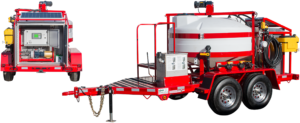
New ultra-high-speed chemigation transforms existing irrigation pivots into all-electric, autonomous crop protection platforms by precisely injecting irrigation-labeled chemical and biological crop protection products directly into the irrigation water supply.

Delivering herbicides, insecticides, fungicides, and other crop protection products through upgraded irrigation pivot infrastructure creates a new capability for more uniform, timely, precise, and effective foliar applications—the application of crop inputs directly to above-ground plant surfaces—with reduced pesticide spray drift and improved crop-canopy penetration using substantially higher carrier-water volumes (~576 gallons per acre) compared with carrier-water volumes used with conventional helicopter aerial spraying (~1.2 gallons per acre).

This new capability enables farmers to extend application windows, improve crop protection efficacy, preserve yield potential, and potentially extend growing seasons while lowering labor requirements, equipment costs, and reliance on aerial application services.

“Many insecticides and fungicides—especially those applied to control pathogens like various rots, molds, and wilts—need to be applied such that the chemical stays on the leaves,” says Dr. Troy Peters, Professor and Director of the Center for Precision and Automated Agriculture Systems (CPAAS) at Washington State University. “A pivot that moves faster can apply less water and therefore results in a more concentrated chemical application that doesn’t run off the leaves. A faster pivot can apply chemicals in a manner closer to that of a sprayer, whose objective is to get the leaves wet, in contrast to an irrigation system whose objective is to get water into the soil.”–Potato Grower Magazine

Conventional start-stop move irrigation pivots can chemigate, but they are fundamentally designed for non-foliar applications, applying crop inputs with sufficient water to reach the soil and root zone. Their slow travel speeds result in relatively high water application depths, making them poorly suited for crop protection products intended to remain concentrated on the plant canopy.

That distinction explains the need for 10x irrigation pivot speed.

The objective is not simply to chemigate—it is to transform the irrigation pivot into an effective, autonomous crop protection platform capable of delivering crop protection products directly to the crop canopy at optimal carrier-water volumes and concentrations for effective foliar application.

The result is a fundamentally expanded use of existing irrigation infrastructure.

Rather than alternating conventional chemigation with costly helicopter aerial spraying, farmers can use the same all-electric irrigation pivot for both irrigation and autonomous crop protection across traditional non-foliar and, now, foliar product applications—dramatically reducing, and potentially eliminating, reliance on helicopters.

“You’re turning my pivot into a sprayer,” says Rexburg, Idaho, potato grower Terry Wilcox.–Potato Grower Magazine

Fieldbot offers a compelling return on investment through higher crop yields, lower production costs, and the elimination of fuel-related emissions associated with conventional aerial application equipment.

By enabling autonomous crop protection through ultra-high-speed chemigation, Fieldbot allows farmers to continuously optimize crop health throughout the entire growing season while advancing a more sustainable, lower-cost, lower-emission approach to high-value crop production.

Commercial adoption of universal Fieldbot Precision Upgrades across small, medium, and large farming operations will initially be driven by autonomous crop protection, delivering immediate and measurable customer value through increases in crop yield of up to 20%—with full-season, supervised, side-by-side field trials demonstrating gains as high as 20.8%—improved crop-input application uniformity, reduced pesticide spray drift, lower labor requirements, reduced equipment cost and complexity, and the potential to reduce agrochemical use by up to 30%.

This creates an initial commercial wedge built on immediate, measurable economic gains for farmers—allowing farmer economics to finance the deployment and expansion of the agronomic intelligence network, while the proprietary AI data aggregated across that network becomes the far larger long-term strategic upside.

Chapter 15

The Results

Improving Customer Outcomes

New ultra-high-speed chemigation versus conventional crop protection product spraying side-by-side field trial comparing two 120-acre Frito-Lay variety chipper potato crops with ten total crop protection product applications each, including scheduled and unscheduled herbicides, insecticides, and fungicides.

Control Field:

Standard start-stop move irrigation pivot with conventional crop protection product application practices requiring a full-time equipment operator, resulting in the following yield and quality outcomes:

Yield: 562 CWT (hundredweight) per acre average
Quality: 16.6 total solids average

Fieldbot Field:

Successfully applied 100% of all scheduled and unscheduled chemical and biological irrigation-labeled crop protection products using an all-electric, autonomous, upgraded irrigation pivot already deployed and operating in the field, resulting in the following yield and quality outcomes:

Yield: 679 CWT (hundredweight) per acre average
Quality: 17.1 total solids average

The Fieldbot Field resulted in a 20.8% increase in yield and a 3.0% improvement in quality over the Control Field.

The net dollar gain from increased crop yield, before accounting for any Fieldbot-related cost savings from lower labor costs, reduced equipment costs, and reduced agrochemical use, is calculated as follows:

(679 CWT per acre x 120 acres x $11.00 per CWT) – (562 CWT per acre x 120 acres x $11.00 per CWT) = $154,440 gain in yield with the Fieldbot Field first year or $1,287 per acre.

Chapter 16

The Scheduling

Revolutionizing Irrigated Agriculture

Decreasing 125-acre single-field rotation times from 24–72 hours to just 90 minutes unleashes an entirely new paradigm in mechanized irrigation.

Rather than treating irrigation as a single, uniform application event, ultra-high-speed constant move enables new variable-frequency irrigation—independently varying both the timing and application depth of water through multi-pass irrigation schedules optimized for differences in soil type, topography, crop demand, weather, and day-night irrigation efficiency (U.S. Patent No. 10,048,663).

This transforms the irrigation pivot from a slow-moving water-delivery system into a dynamic agronomic management platform matching water applications far more precisely to the crop’s spatial and temporal needs.

By prescriptively optimizing when, how much, and in which sectors water is applied with each multi-pass, variable-frequency irrigation has the potential to fundamentally redefine irrigation scheduling and revolutionize irrigated agriculture.

Moreover, ultra-high-speed constant-move operation uniquely enables several entirely new irrigation treatments, including small-seed germination, hay-dew simulation, and crop-canopy cooling passes.

Chapter 17

The Sensing

Harvesting the Data

Fieldbot, operating at the edge of the legacy irrigation pivot industry but within the broader agricultural equipment and technology sector, is uniquely positioned to unlock the enormous precision upgrade potential of the global installed base of mixed-fleet, electrically driven irrigation pivots—transforming these existing machines into intelligent, connected autonomous crop platforms that continuously generate and aggregate the diverse, full-season, high-fidelity proprietary intervention-and-response datasets required to train, improve, and differentiate the agricultural AI that will increasingly inform and enhance agronomic decisions while automating agronomic interventions at scale.

In effect, every upgraded irrigation pivot becomes a giant data-harvesting robot—an autonomous, category-defining, field-scale agronomic machine platform that remains physically resident in the field with the crop throughout the entire growing season, continuously capturing and connecting farmer-developed knowledge and expertise, agronomic intervention histories, successive plant-level observations of real-world biological crop responses, and increasingly intelligent machine actions.

Rather than merely irrigating, fertigating, and chemigating crops at field scale, the pivot becomes persistent infrastructure for continuously generating and aggregating diverse, full-season, high-fidelity proprietary intervention-and-response datasets with exceptional spatial and temporal resolution and unprecedented economic efficiency.

Operating continuously throughout the entire growing season while orbiting directly above the crop canopy, an upgraded irrigation pivot equipped as standard with a single camera module at the outer end of the machine can autonomously capture high-resolution multispectral crop imagery—scanning 2.8 acres along the field perimeter for early detection of crop stress as well as disease and insect pressures entering the field—while the same all-in-one agronomic machine platform simultaneously records every application of water, fertilizer, and crop protection products, including what was applied, when it was applied, and how the crop responded biologically to each intervention over time.

Daily, ultra-high-speed “non-irrigation passes”—completed in just 90 minutes to minimize disruption to irrigation schedules and regularly scheduled at the hottest time of day, when water-use efficiency is at its lowest—unlock autonomous crop imaging that produces a novel, full-season visual record of the crop’s growth, stress, and biological response to agronomic interventions.

Fieldbot uploads high-resolution multispectral crop imagery autonomously captured by on-pivot Sentera Field Vision remote-sensing systems—GPS-enabled and connected to the cloud via Starlink—to the Sentera FieldAgent™ data analytics platform, which produces increasingly intelligent, actionable agronomic insights and data-driven recommendations over time.

In addition, and for the first time, this continuous stream of imagery creates a longitudinal understanding of crop development across the entire growing season, from germination through senescence, at near-zero marginal cost.

These same high-resolution images enable Fieldbot to continuously generate and aggregate diverse, full-season, high-fidelity proprietary intervention-and-response datasets.

By correlating every agronomic intervention with measured biological crop responses, Fieldbot creates a uniquely differentiated layer for continuously advancing increasingly capable, self-improving agronomic intelligence and autonomous crop management—the foundation of agricultural AI.

Chapter 18

The Intelligence

Training the models

For customers who elect to license their data, every upgraded irrigation pivot becomes a continuously operating agronomic sensing platform—capturing participating farmers’ agronomic interventions and converting generations of traditionally unwritten, farmer-developed agronomic knowledge and expertise into structured intelligence by recording applications of water, fertilizers, and crop-protection products, then repeatedly observing how crops respond biologically to those interventions, how those responses evolve over time, and how environmental conditions influence crop performance and yield.

By systematically and autonomously capturing successive plant-level observations of real-world biological crop responses and environmental conditions at 24, 48, 72, and 96 hours following every application of water, fertilizers, and crop-protection products throughout the entire growing season, Fieldbot, in collaboration with participating farmers, can generate and aggregate uniquely structured, diverse, full-season, high-fidelity proprietary intervention-and-response datasets that precisely correlate specific agronomic interventions with subsequent biological crop responses over time.

These high-frequency temporal datasets can reveal how crops respond biologically to what was applied, when, where, and under which environmental conditions—and can optionally be combined with planting and harvest data to close the full-season loop—creating a compounding foundation of real-world, self-improving agronomic intelligence that can continuously train, improve, and differentiate proprietary agricultural AI models—or post-train, ground, and specialize increasingly capable frontier AI models for agricultural applications.

Just as a Large Language Model (LLM) learns from language, proprietary agricultural AI models learn from crops—continuously improving their understanding of planting performance, crop health, water demand, nutrient response, disease and insect pressures, crop-input effectiveness, and yield outcomes across millions of engaged acres.

Autonomous machine action is not the endpoint.

The next step is to enable machines to continuously observe and learn from biological crop responses to every autonomous action over time and throughout entire growing seasons.

With the next generation of autonomous technology, upgraded irrigation pivots will integrate a multimodal vision-language-action (VLA) model to wrap an autonomous execution harness around the proprietary agricultural AI models, creating a persistent, closed, and compounding Physical AI learning loop between agronomic intelligence and agronomic intervention.

This loop will continuously translate successive plant-level observations of real-world biological crop responses into agronomic decisions; agronomic decisions into autonomous agronomic interventions and machine actuation; and the resulting biological crop responses into new, diverse, full-season, high-fidelity proprietary intervention-and-response datasets that further train, improve, and differentiate the proprietary agricultural AI models.

Agronomic intelligence becomes machine automation.

Chapter 19

The Network

Closing the loop

Together, these upgraded irrigation pivots are far more than an ever-expanding network of agriculture’s most widespread field-scale agronomic machine platforms.

They are the foundation of what could become the world’s most valuable distributed, self-improving agronomic intelligence network—one capable of continuously learning from every field to improve every field.

This creates a powerful network effect—The Pivot Flywheel™—a self-reinforcing agronomic intelligence network that, with every additional connected machine, field, crop, geography, and growing season, continuously generates and aggregates more diverse, full-season, high-fidelity proprietary intervention-and-response datasets, improves the underlying proprietary agricultural AI models, advances self-improving agronomic intelligence, and enables increasingly intelligent, actionable agronomic insights and data-driven recommendations over time.

As more upgraded irrigation pivots join the network, this compounding, self-improving agronomic intelligence enables increasingly precise agronomic recommendations and decision-making, increasingly capable agricultural AI models and autonomous machine action, better customer outcomes, and a more difficult-to-replicate competitive moat built on a proprietary AI technology stack spanning motors, controls, sensing, data, compute, and connectivity.

By closing the loop among farmer-developed knowledge and expertise, agronomic interventions, and successive plant-level observations of real-world biological crop responses, Fieldbot transforms self-improving agronomic intelligence from retrospective analysis into a persistent, farm-facing agronomic learning system.

The resulting diverse, full-season, high-fidelity proprietary intervention-and-response datasets create a differentiated training and post-training resource for agricultural AI while also grounding and specializing increasingly capable general-purpose foundation models with real-world agronomic intelligence.

The agricultural AI that ultimately proves most valuable may not simply be the one trained on the largest historical agronomic datasets, but the one connected to the largest, most persistent network of farm-facing machines capable of continuously generating and aggregating new real-world agronomic experience from which the AI can learn, improve, and compound self-improving agronomic intelligence.

As agricultural AI moves from answering questions to recommending and ultimately executing physical actions, the ability to observe the resulting biological crop responses—and continuously feed that real-world experience back into a self-improving agronomic intelligence layer—can become an increasingly important source of differentiation.

Fieldbot’s opportunity is to provide this persistent, farm-facing physical agronomic learning infrastructure at global scale.

Chapter 20

The Future

Enabling the Operating System

The opportunity to accelerate agriculture’s transition to abundant intelligence extends far beyond irrigation.

In the future, farmers growing crops across both “irrigated and non-irrigated” acres worldwide can interact with vast teams of dozens—or eventually hundreds—of increasingly personalized and specialized agricultural AI agents and AI assistants spanning crop production, irrigation, nutrition, crop protection, equipment, weather, economics, and marketing.

Fieldbot’s opportunity is to provide these emerging agentic intelligence systems with something uniquely valuable—a persistent, farm-facing agronomic learning infrastructure at global scale—one that continuously captures, generates, and aggregates farmer-developed knowledge and expertise, agronomic interventions, successive plant-level observations of real-world biological crop responses, and increasingly intelligent machine actions through a proprietary, purpose-built data-generation engine: upgraded irrigation pivots.

Whether delivered through Fieldbot applications or integrated into third-party specialized foundation models, this intelligence can enable multiple agricultural AI agents and AI assistants across the farming operation—each focused on a particular crop, field, agronomic discipline, piece of equipment, risk, or business objective while working together as a unified agricultural AI system—not merely to answer questions about what happened on the farm, but increasingly to understand what is happening now, recommend what should happen next, execute approved agronomic interventions, observe the resulting biological crop response, and learn from the outcome.

Connected through shared memory, each agricultural AI agent and AI assistant applies the collective intelligence of the broader proprietary agricultural AI models while simultaneously contributing new observations, decisions, interventions, and outcomes that continuously compound its underlying self-improving agronomic intelligence.

Every observation strengthens the models. Every growing season makes every agent and assistant smarter. Every participating farm benefits from what the network has already learned.

Agriculture still runs on farmer knowledge, agronomic judgment, biological experience, and contact with the physical world.

AI increases—not decreases—the strategic value of capturing, structuring, preserving, and continuously expanding that knowledge.

As increasingly capable AI models become broadly accessible, the enduring advantage in agricultural AI may shift from ownership of the model itself to control of the proprietary Physical AI infrastructure layer through which self-improving agronomic intelligence continuously acquires new agronomic experience, retains the consequences of prior actions, and learns from the biological responses of crops over time.

Fieldbot’s enduring advantage lies not in any single proprietary agricultural AI model, but in the farm-facing physical agronomic learning infrastructure that continuously generates and aggregates proprietary real-world agronomic experience from which increasingly capable agricultural AI can learn, improve, and compound.

What begins as a scalable and profitable precision upgrades business in the agricultural equipment and technology sector can grow into the world’s leading platform for self-improving agronomic intelligence and, ultimately, the farm-facing physical agronomic learning rail that underlies and enables agricultural AI—the operating system of agriculture—connecting machines, fields, crops, and farmers worldwide.

This future is built not by replacing existing agricultural equipment, but by transforming the global installed base of mixed-fleet, electrically driven irrigation pivots into an intelligent, connected, autonomous fleet—repurposed for entirely new capabilities, greater precision, and the continuous advancement of increasingly capable, self-improving agronomic intelligence and autonomous crop management.

Chapter 21

The Asset

Monetizing the infrastructure

Every upgraded irrigation pivot can additionally transform traditionally under-monetized agricultural infrastructure into a new farmer-owned digital asset—creating additional economic value from the proprietary AI data generated across the farming operation and unlocking two entirely new revenue streams beyond the sale of crops.

First, customers can elect to license their proprietary AI data—capturing the relationships among agronomic interventions, crop responses, environmental conditions, and agronomic outcomes—in exchange for economic value and increasingly intelligent, actionable agronomic insights and data-driven recommendations over time—generated from successive plant-level observations of real-world biological crop responses and the compounding agronomic intelligence of increasingly capable agricultural AI models.

Farmers retain control over whether and how their data is contributed, accessed, aggregated, and commercialized, while Fieldbot, through licenses granted by customers who elect to license their data, continuously generates and aggregates diverse, full-season, high-fidelity proprietary intervention-and-response datasets that continuously train, improve, and differentiate proprietary agricultural AI models—or post-train, ground, and specialize increasingly capable frontier AI models for agricultural applications.

Second, during the agricultural off-season, the same electrical grid-powered, Starlink-connected, onboard inference compute deployed across upgraded irrigation pivots can be made available as distributed computing infrastructure, enabling farmers to monetize otherwise idle compute capacity.

Together, these capabilities create a new agricultural economic model in which farmers are not merely users of agricultural AI but participants in the value created by the proprietary AI data, knowledge, and distributed computing resources generated and contributed through their farms.

Chapter 22

The Team

Managing the Vision

Fieldbot’s management team comprises experienced professionals with deep expertise in mechanized irrigation, agricultural technology, and irrigation systems and infrastructure.


Kevin Abts – Fieldbot Founder and CEO

Successful background spanning systems engineering, technology development, product design, sales and marketing, strategic planning, and technical writing across mechanized irrigation, with multiple issued patents, published articles, and award-winning products.

  • Founder with extensive experience in mechanized irrigation and agricultural technology.
  • Co-founded CropMetrics (industry-first VRI Rx software platform, acquired by CropX).
  • Inventor of FieldSENTRY (acquired by Lindsay Corporation and renamed Lindsay FieldNET).
  • Bachelor of Science and Master of Science degrees in aerospace engineering.


Gary Kaplan – Fieldbot COO and CFO

Extensive corporate experience managing major infrastructure projects and technology-services businesses.

  • Background in irrigation systems and infrastructure.
  • Former VP Market Services at Lindsay Corporation.
  • Head of Lindsay FieldNET leadership and product launch.
  • Master of Business Administration and accounting degrees.
Chapter 23

The Storm

Rising insurance costs

High winds are a recognized and costly source of irrigation pivot losses: North Dakota State University notes that high winds can flip entire irrigation pivots, while Nebraska Extension reports that storm-damaged irrigation pivots cause high-dollar losses nearly every year and have contributed to rising irrigation pivot insurance costs.

With over 55,000 irrigation pivots in Nebraska alone, the scale of individual severe-weather events can be extraordinary. A 2004 severe-weather outbreak damaged or destroyed more than 250 irrigation pivots in south-central Nebraska, according to NOAA records, while a 2014 Nebraska storm reportedly took down 260 irrigation pivots in a single event, with estimates that as many as 500 irrigation pivots were down across the greater Minden area during the broader period of severe weather.

Wind and storm damage can destroy hundreds of machines—representing millions of dollars in replacement costs—in a single regional weather event, creating substantial recurring exposure for farmers, equipment manufacturers, dealers, and insurers.

Nebraska Extension is currently studying factors that may reduce this exposure—including which direction an irrigation pivot should be parked and whether a machine is less likely to be damaged while irrigating—precisely the variables that an intelligent, ultra-high-speed constant-move irrigation pivot could autonomously control.

Chapter 24

The Protection

Reducing Storm-Damage Premiums

Fieldbot is developing a fourth new core machine application: autonomous storm protection, a new capability that transforms an upgraded irrigation pivot into an active storm-protection system.

By integrating large-scale, real-time weather datasets—including radar, severe-weather alerts, forecast wind speed and direction, and localized storm tracking—with the irrigation pivot’s position, heading, and ultra-high-speed constant-move capabilities, the system could anticipate approaching high-wind events and autonomously reposition the machine directly into prevailing straight-line winds.

Rather than leaving a conventional irrigation pivot stationary and exposed in an arbitrary position, an upgraded irrigation pivot capable of completing a full revolution in approximately 90 minutes could rotate up to 90 degrees in as little as 22.5 minutes—rather than hours—rapidly repositioning the machine into a more favorable orientation before the strongest winds arrive.

Moreover, if the upgraded irrigation pivot were shut down when a severe-weather threat was detected, the system could remotely start the machine, determine the optimal storm position, and autonomously move the irrigation pivot there—without requiring the farmer to travel to the field during dangerous weather.

Once positioned, the system could also activate the irrigation water, filling the pipe spans and applying water through the sprinklers to add operating weight and potentially increase the machine’s resistance to wind-induced movement or overturning.

The result would be a new form of predictive physical risk mitigation in which weather intelligence does not simply warn the farmer that a storm is approaching—it enables the machine to physically act before the storm arrives.

This capability could ultimately create an entirely new relationship between irrigation pivot technology and agricultural insurance.

Because upgraded irrigation pivots could automatically document incoming weather conditions, machine position, repositioning time, water status, and protective actions taken before a storm, insurers could quantify the technology’s effect on loss frequency and severity across a large, mixed-fleet installed base.

If claims data demonstrate a statistically meaningful reduction in catastrophic wind losses, insurers could recognize upgraded irrigation pivots as lower-risk insured assets and offer reduced storm-damage premiums or other underwriting incentives—turning autonomous storm protection from an equipment feature into a measurable risk-management product for farmers and insurers alike.

Over time, storm-damage insurance could potentially be integrated directly into the Solutions-as-a-Service offering, combining autonomous storm protection, continuous risk monitoring, and insurance coverage within a single recurring customer solution.